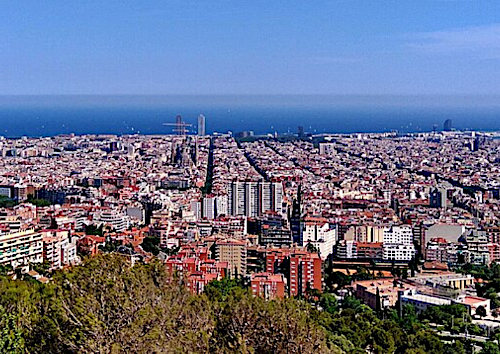

View of city and sea from Park Guell – unknown author on Wikimedia
At the end of the 19th century Barcelona became well known for the Catalan Modernisme movement, exploding elsewhere within Europe as Art Nouveau, but expressed here not just in architecture with a Catalan identity but in a cultural movement as well.
Although many architectural geniuses contributed to the style of this beautiful city, Antoni Gaudi is considered one of the top exponents of the style, combining Asian, Islamic, and Art Nouveau influences to create his own unique approach.
I spent several days exploring this vibrant city, experiencing three of his most exemplary works.
 Casa Batllo illuminated for the ‘A Winter’s Night’ experience @Casa Batllo S.L.U
Casa Batllo
Casa Batllo is a UN World Heritage Site and without a doubt the crown of my visit to Barcelona. Located on Passeig de Gracia near the city center, it’s one of Gaudi’s masterpieces, his most complete work, and what many consider the most accessible jewel of Catalan Modernism.
Approaching the surreal violet illuminated facade I immediately saw how Gaudi unleashed his imagination to create a structure in his own personal style. The fanciful facade gives it an Impressionist look and feel, some even comparing it to Monet’s ‘Water Lilies’. Salvador Dali agreed with this water interpretation, writing “Gaudi has built a house according to the shapes of the sea, representing the waves on a calm day.”
I started with the night-time magic of A Winter’s Night, an exciting production that has already been seen by more than 200,000 people. The experience includes a full tour of the house, special lighting and spectacular projections, an augmented reality 360 degree room and a choice of different stories capturing the lives of former residents. Awarded Europe’s Best Immersive Experience, it is a must-see for anyone who wants to understand Gaudi’s mind and the essence of Catalan modernism. This is a definite must-do before visiting any other Gaudi works for a deeper understanding.
Next I explored the Noble floor, a suite of interconnected living spaces that Gaudi
crafted as the residence of the Batllo family — these are organic shapes, every piece of hardware and stained glass is an ergonomic, nature-inspired form. Continuing upwards through the light well central atrium I find the rooftop terrace, where the intricately mosaic clad chimneys compete with views of Barcelona for your attention.
 Sagrada Familia side view, Barcelona, Catalonia
 Sagrada Familia
Probably the most well-known of Gaudi’s works has still not been completed, although it was begun in 1882.
A deeply religious man, Gaudi devoted everything to this church. In his later years he even took up residence in the uncompleted structure and finished the final decades of his life there.
Using the knowledge I’d gained from exploring Gaudi’s thoughts at the Casa Batllo exhibit earlier, I decided to visit in the morning. Entering through the Nativity Facade, the oldest and most ornate, Gaudi designed this entrance to light up the basilica with blues and greens. This resembles the natural environment with morning light reflecting through the columns as if they were trees. Once in the interior look right towards the intricate design of the soaring stained-glass Apse, and if your tourist pass includes a Tower Tour, I highly recommend it for the views of Barcelona. Make sure to visit his crypt downstairs too. I left through the Passion Facade and compared this to the Nativity Facade from which I entered, completed from his drawings after his death in a more austere and subdued style.

Park G?ell, Dragon Staircase @unknown author on Wikimedia
Park Guell
Originally this plot of land on Carmel Hill overlooking the city was planned for an upscale housing development. A park inspired by the traditional English City Garden was built by Gaudi to promote it, but alas, the lots didn’t sell and housing was never constructed. Eventually the city bought the land, preserved it as a public park, and established a museum to honor Gaudi.
I began at the entrance by the two whimsical entrance houses and ascended the richly decorated Esaclier du Dragon staircase, stopping to look at the selfie photo takers at the El Drac dragon statue. At the top is the Hypostyle Room, commonly referred to as the Market Hall, inspired by classic Greek architecture with Doric columns. After taking in the rich mosaics and octopus designed ceiling I continued upward to Nature Square (Plaza de la Natura), a large plaza built on top of the Hypostyle to hold open-air markets, festivals, and concerts. Surrounding the perimeter of the plaza is the Serpentine Bench, the ergonomic seats giving me stunning views of Barcelona and the sea beyond — a must-see on any clear evening. And for more fabulous views visit the Park Guell Cavalry.
When you go:
- Casa Batllo is reached on the Barcelona Metro lines L3 (Green Line) and L4 (Yellow Line), with the nearest station being Passeig de Gracia.
- Sagrada Familia is reached by the L2 (purple line) and the L5 (blue line). Both lines stop at the Sagrada Familia station.
- Park Guell is reached by the L3 (Green Line) with the closest stations being Vallcarca or Lesseps. From either station, it takes about 20 minutes to walk to the park entrance.
Links:
Casa Batllo
Sagrada Familia
Park G?ell
For more ITKT travel stories about Spain
For more ITKT travel stories about Europe
Written by: Steve Smith
Steve inherited the wanderlust and has always needed to see what’s around the next corner. In his college years he enjoyed many memorable (and cheap) forays into Mexico sleeping under the stars, but today that’s all changed. Since 2006 he’s contributed stories and photographs to In The Know Traveler, and in 2014 he assumed an editor role with the same. Published both in digital and print formats, his international assignments have taken him to the Middle East, Asia, North/Latin/South America, Europe, and the Caribbean. Follow his Facebook page Steve’s Roadtrippin’ Travels that spotlights both his photography and how his road travels intersect with digital storytelling using dynamic space-age mapping technology.
For more of Steve’s travel stories